Frequently Asked Questions

about the Community Foundation for Northern Virginia

Below we have compiled some frequently asked questions of the Community Foundation Staff.  We hope this is helpful, but if you would like to speak with our team directly, please contact us today.

About Community Foundations and CFNOVA

A community foundation is a nonprofit organization that helps people, families, and businesses invest in the communities they care about. It brings together charitable resources, local knowledge, and long-term stewardship to address community needs and create lasting impact.  

Founded in 1978, the Community Foundation for Northern Virginia serves the counties of Fairfax, Loudoun, Arlington and Prince William, and the cities of Alexandria, Falls Church, Fairfax, Manassas and Manassas Park. We steward charitable funds, award grants and scholarships, provide research and community leadership, and connect generous people with local organizations working to address the region’s most pressing challenges. Our goal is to make Northern Virginia a thriving, inclusive community for everyone. 

Since 1978, CFNOVA has invested more than $100 million to support education, health, housing, and other community priorities across Northern Virginia, working alongside donors, nonprofits, and civic leaders to strengthen our region. We know the region well, we study its needs, and we work with local leaders to find solutions. We also help donors make the biggest possible impact with their giving. 

Our data and research center, Insight Region®, sets us apart. It is dedicated to understanding the unique needs, trends, and opportunities within Northern Virginia’s neighborhoods, towns, and cities—helping donors and partners make informed, effective decisions.  

We are a 501(c)3 nonprofit organization, but while most charities focus on one issue, like hunger or housing, CFNOVA supports many different needs across Northern Virginia. We do this not only through our research, grants, and scholarships, but also through our partnerships with donors. Our donor funds are managed responsibly so your gifts make a long-term difference. 

CFNOVA is a trusted charitable giving partner, and meets National Standards for U.S. Community Foundations, undergoes annual audits, and shares clear reports so donors can trust how funds are managed. 

We serve Northern Virginia, including Fairfax, Loudoun, Arlington, Prince William, and the cities of Alexandria, Falls Church, Fairfax, Manassas, and Manassas Park.
CFNOVA is governed by a volunteer Board of Directors and staffed by nonprofit professionals dedicated to serving the Northern Virginia region. 

Funds & Giving Options

A donor advised fund is a philanthropic vehicle established at a public charity like a Community Foundation. It allows donors to make a charitable contribution, receive an immediate tax deduction, and then recommend grants from the fund over time. A donor advised fund is like a charitable savings account. The donors contribute to their funds as frequently as they like, then recommend grants to their favorite nonprofits, schools or faith based organizations from the fund when they are ready.

For detailed information about donor advised funds here at the Community Foundation, see our Donor Handbook.
A private foundation requires substantial start-up costs and administrative expenses, such as the yearly filing of a Form 990-PF. A donor advised fund at a Community Foundation requires very little work on the donor’s part—the Community Foundation staff is here to serve you. Moreover, donor advised funds allow donors to take a federal income tax deduction up to 50% of adjusted gross income (AGI) for cash contributions and up to 30% of AGI for appreciated securities; versus 30% of AGI for cash contributions and 20% of AGI for appreciated securities for a private foundation. Donor advised funds also offer the ability to make grants anonymously, if desired.

For a more detailed comparison of a donor advised fund and a private foundation, click here.
Yes. By converting your private foundation to a donor advised fund at the Community Foundation, you maintain the name of your foundation (or you can choose an anonymous name) and you maintain the advisory capacity over grant making while the Community Foundation manages all of the administrative duties such as accounting, grant application due diligence, grants follow-up, and all IRS reporting. Furthermore, you have the opportunity to resource the experience and knowledge base of our professional staff about the critical needs of our region.

There are many advantages that a donor advised fund at the Community Foundation offers over a private foundation. In terms of immediate tax benefits, it is important to remember that the Community Foundation is a public charity, and therefore
  • Tax deductions of as much as 50% AGI are possible
  • 5% annual pay out is not required
  • Excise taxes do not apply
Learn more about the benefits of converting a private foundation to a donor advised fund.
The primary advantage of establishing a donor advised fund at the Community Foundation for Northern Virginia is the opportunity to work with and support a local non-profit organization engaging in community leadership and helping to build local community. Grants from any donor advised fund, whether it is established with the Community Foundation or with a commercial gift fund, may be recommended anywhere in the domestic United States. However, the Foundation Support Fees collected on donor advised funds established at the Community Foundation for Northern Virginia support the organization’s research and publication of data driven reports on critical community needs, emergency grants to basic needs assistance programs serving Northern Virginia, community events and seminars focused on local needs, and donor education events that improve the impact of our collective grant making.

In addition, when you open a donor advised fund at the Community Foundation for Northern Virginia, you will receive many personalized benefits that a commercial gift fund cannot offer, including:
  • Invitations to special donor receptions and donor events
  • Data and information on the critical needs of Northern Virginia
  • Immediate access to the professional staff at the Community Foundation and an annual meeting to discuss how grants from your fund can have an impact and make a difference.
Donor advised funds provide a number of benefits that direct donations to a charity may not, including:
  • The ability to accept and process appreciated securities on which the donor does not have to pay capital gains tax.
  • A variety of investment options allowing the contribution to potentially grow over time.
  • The capacity to receive one block of securities that can benefit multiple charities.
  • The creation of a legacy versus providing a one-time gift.
  • A separation of tax planning and charitable giving, which provides a full tax deduction to the donor when the contribution is made but enables the donor to recommend grants from the fund for years to come and even beyond the donor’s lifetime.
  • A single contribution that benefits multiple charities while only requiring one tax substantiation letter.
  • An avenue for families to actively participate in the grant-making process together.
  • A long-term vehicle for philanthropy in one or more area(s) of interest without needing to determine the recipient at one time.
  • Pooled funds for investment management purposes, which minimizes costs while achieving a greater return, making it possible for smaller individual funds to enjoy the same economies of scale as large independent foundations.
The first step is to sign a standard donor advised fund agreement with the Community Foundation. Community Foundation staff will customize the fund agreement to reflect the charitable focus of your fund, what you want to name it, whether there will be successor advisors on the fund, and if so, who, and whether the fund is being established as a permanent endowment (available annual grantmaking may not exceed 5 percent of the fund balance) or a pass through (available grantmaking is not restricted) fund. In most instances, it takes just a couple of hours to finalize and sign the fund agreement.

For more information on setting up a donor advised fund, visit our Establish a Fund page.
You can make gifts of cash and marketable securities to your fund at the Community Foundation. You can also make gifts of real estate, closely held corporation stock and other “unmarketable” securities, partnership interests, life insurance policies, retirement plan assets, charitable remainder trusts, pooled income funds, charitable lead trusts, and other tangible and intangible property, so long as those gifts meet the guidelines of the Community Foundation’s Gift Acceptance Policy, which policy is available upon request. Many donors prefer to contribute appreciated assets such as appreciated stock so that they obtain a tax deduction for the fair market value of the asset on the date the gift is made and avoid paying taxes on the gain. Most charitable gifts to donor advised funds qualify for maximum tax advantage under federal law.

The Community Foundation for Northern Virginia works with investment management firm Goldman Sachs to manage a large portion of our assets (known as the “pooled funds”). Goldman Sachs was selected after a competitive process that was conducted by our board level Investment Committee. Goldman Sachs directly reports to the Investment Committee at least quarterly and provides their experience and unique capabilities for a very reasonable, comprehensive annual fee. Click here for more information about our investment program, including the most current report describing the allocation and performance of the pooled endowment.


Grants & Scholarships

Applicants can explore our grant opportunities and apply online when the grant processes are open. The Community Foundation works hard to reach out across the entire qualified area for quality programs that have a strong impact on our communities and the region. The staff and a grants committee review the proposals annually or more frequently if needed.
Yes. The Community Foundation holds roughly 25 active scholarship funds and awarded more than $250,000 to more than a 100 students in 2020.
When we receive a signed copy of your new fund agreement, we will send you a “welcome” packet that includes a fully executed copy of your fund agreement and that explains the process of recommending grants from your fund. In brief, grant recommendations may be submitted in two ways: by a Grant Recommendation Form, which can be downloaded from our website or through your personalized Donor Portal account.
In most cases, it takes approximately 2 weeks for the Community Foundation to mail the grant check after our receipt of the grant recommendation. Community Foundation staff regularly updates donors on the progress of their grant recommendations. If submitted on Donor Portal, donors can also track the progress there.
No. Grants from donor advised funds can be recommended to any non-profit, school (excluding for-profit schools), or faith-based institutions. We now offer the opportunity to make international grants in addition to the domestic US.

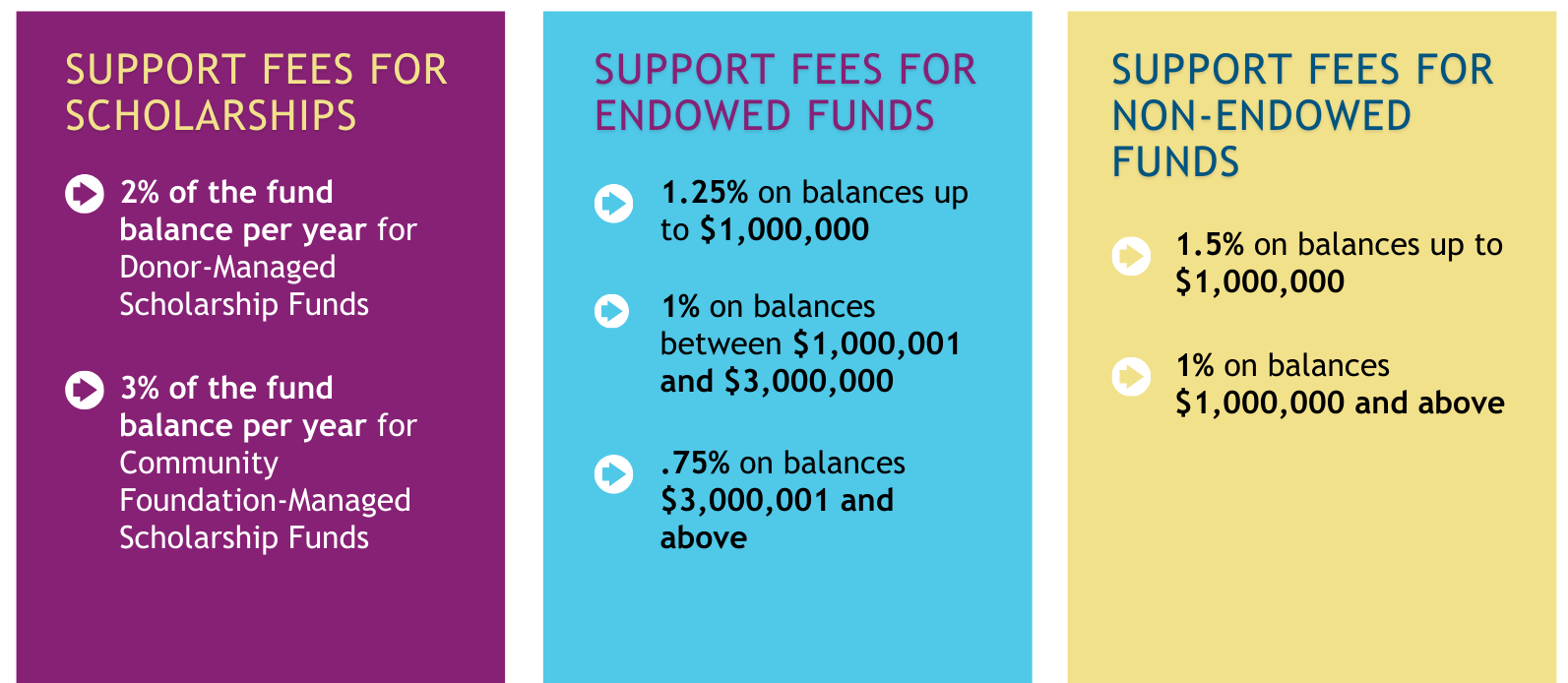
Fees & Minimums

Yes, donor advised funds must be established with a minimum $10,000 contribution.

Donor Services & IRA Gifts

The Community Foundation’s Philanthropic Services team stands ready to assist all donors to fulfill your charitable goals.

Many of the services and special benefits you receive as a donor are as follows:
  1. An invitation to special donor receptions and donor events
  2. The flexibility to give anonymously
  3. Data and information on the critical needs of our region
  4. The opportunity to provide input on the Community Foundation’s programs and initiatives
  5. An invitation to become a member of the Community Foundation’s discretionary grant cycle review committee
  6. An annual meeting with Community Foundation professional staff to discuss how grants from your fund can have an impact and make a difference
  7. Recognition in the Community Foundation’s annual reports

In addition, we can help connect you to the causes you care about most. Our professional staff has broad expertise regarding community needs and issues. We have a deep knowledge of the critical needs of Northern Virginia, so we can help you find quality nonprofit programs and services that match your charitable giving style. We routinely perform due diligence on most local nonprofits, insuring that they are bona fide, in good standing, well managed and financially sound.
Many of today’s retirees have amassed considerable wealth in their IRAs, more wealth, in fact, than they need for daily living or long-term care. And for those with substantial estates, much of their IRA wealth will go to estate taxes and income taxes of non-spousal beneficiaries, leaving some heirs with less than 50% of the IRA assets that are left to them. For these reasons, many of today’s IRA holders should consider using their IRAs as a current source of charitable gifting.
IRAs are typically held by a financial advisor or trust company. These custodians can provide a form that could be used to transfer the IRA directly to charity.
No. A charitable gift from an IRA is not itemized and therefore donors may not take an income tax deduction for them. But the good news here is that the amount of the IRA withdrawal that is used for the charitable gift is not counted towards a donor’s adjusted gross income or AGI. AGI is used to determine whether certain tax provisions apply, such as the 3.8% surtax on net investment income, to determine payments for some Medicare premiums, or to determine taxes on Social Security payments. Moreover, AGI is used to determine whether itemized deductions receive are reduced or receive a ‘haircut’ once certain thresholds are met. By excluding the amount of the IRA withdrawal that is used for the charitable gift from AGI, a donor is likely to see an overall reduction in income tax liability and may minimize any reduction in their itemized deductions
Donors who are 70½ years of age or older need to start taking annual required minimum distributions from their IRA accounts, incurring tax liability on income they often do not need and would prefer to avoid. The current law permits individuals to transfer up to $100,000 per year from their IRAs to a qualified charity, all of which can count towards the required minimum distribution a donor would otherwise be required to take with none of the concomitant income tax liability attaching thereto.
Under current law, gifts from IRAs may not benefit donor advised funds and supporting organizations. In addition, split interest gifts, such as charitable annuities, charitable lead trusts and charitable remainder trusts, do not qualify.